
Transaction Trends provides private equity sponsors and investors with middle-market transaction information and insights compiled by the BMO Sponsor Finance group—information that helps sponsors and investors better understand the current financing climate in the middle market.
A quick look back at 2025
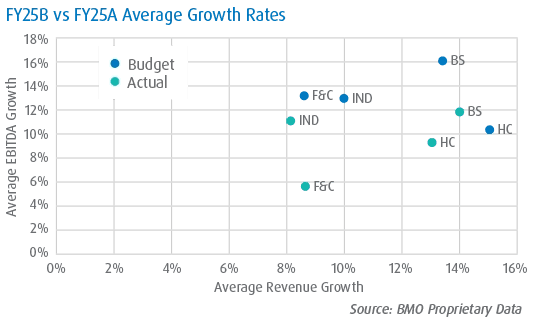
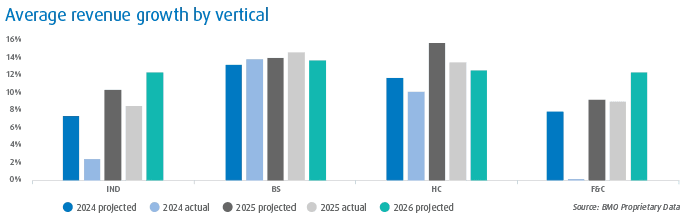
Coming into 2025, the budgeted outlook was unmistakably optimistic. Sponsors and management teams were looking forward to a period that signaled a more constructive macro backdrop. The incoming administration was widely viewed as business friendly—promising to slash regulatory hurdles, cut taxes and reduce interest rates. Oil prices were stable and favorable, and there was hope that geopolitical distractions—most notably the war in Ukraine—would be resolved. Against that backdrop, many businesses were feeling understandably optimistic. Projected 2025 growth rates for all sectors were expected to be in double-digits. This top-line growth and stable cost environment were expected to create the operating leverage would result in expanded EBITDA margins.
The macroeconomic backdrop
As the year unfolded, optimism gave way to uncertainty as Liberation Day introduced significant volatility into the supply chain. With an ever evolving tariff landscape over the course of several months, it created an exceedingly difficult environment for middle-market companies to navigate. Companies responded by accelerating supply chain diversification and redundancy efforts not knowing where negotiations would land.
Many companies in the portfolio engaged in inventory pre-buys and carried higher inventory levels as a hedge against disruption. Price increases and supplier cost reductions were commonplace with some industries quoting increased costs of 10%+. Stable unemployment rates gave the Fed the ability to combat these higher costs with a “higher for longer” rate strategy. This had the effect of creating an unexpectedly tight liquidity environment in 2025—just as many companies were expecting growth from post-COVID investments to begin paying off.
As the year unfolded, optimism gave way to uncertainty as Liberation Day introduced significant volatility into the supply chain.
Growth across the portfolio but below expectations
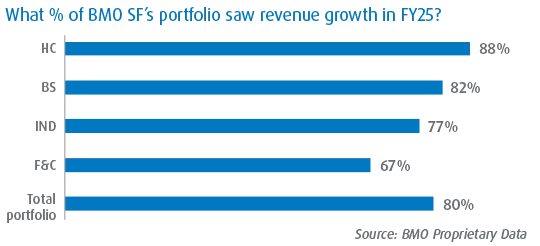
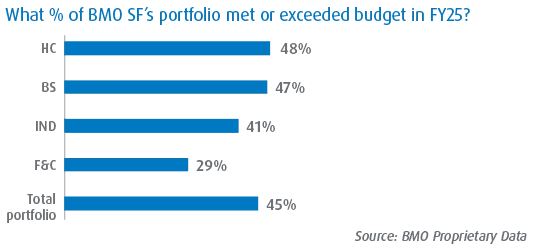
Against that backdrop, 2025 performance was mixed but resilient at the portfolio level as most borrowers demonstrated revenue growth in 2025. Unsurprisingly, sectors less impacted by tariffs and costs, such as healthcare and business services, saw the best results. Food price inflation, supply chain disruption, and moderating wages (albeit stable employment) resulted in a weaker consumer and drove underperformance in our Food & Consumer portfolio. On the other hand, we did not see pullback in investment. SG&A across the portfolio remained stable and an an effort to delay price increases against higher costs drove margin pressure—resulting in over the half the portfolio falling short of budgeted EBITDA.
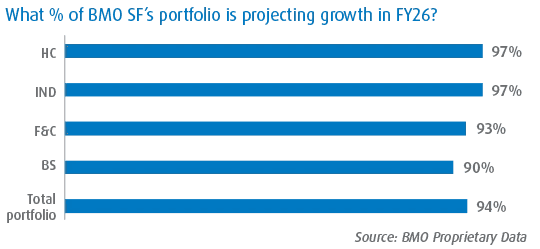
Optimism remains in 2026 despite ongoing headwinds due to stubborn cost inflation and geopolitical concerns—nearly the entire portfolio is expecting growth in 2026. The question is how predictive have budgets been historically and should we believe this is a sign of a growing economy? Accuracy in budgets is akin to peering into the crystal ball at a singular point in time—facts change over the course of the year. Interestingly, and perhaps unsurprisingly, the Industrial and Food & Consumer sectors have had the least accuracy in budgeting. Why is this? These companies often have complex, international supply chains—many actively working to reduce China dependency in 2025. For Industrials names, higher-for-longer interest rates could curtail capital availability, or hamper returns on new manufacturing investment. For Food & Consumer names, the lack of wage growth is creating a cautious consumer—with consumer sentiment touching decade lows.
Notable, however, as we end the first quarter, is that we are now receiving first quarter results for 2026. At the time of this writing, 90% of the S&P 500 had reported earnings. 84% have reported positive EPS surprise and 80% reported positive revenue surprise. If this is any indication of what to expect from the middle market, then we expect to see bullishness throughout 2026, despite headwinds.
Realizing value with BMO Treasury & Payment Solutions
Consistency, speed and execution certainty are crucial to servicing the needs of middle market private equity firms. These same characteristics apply directly to portfolio companies’ working capital management and cash flow optimization.
At BMO Sponsor Finance, we provide the capital and expertise for LBOs, mergers and acquisitions, and growth capital, and with the vast resources of a top 10 Commercial Bank, we are uniquely positioned to extend that support beyond the deal and offer a full suite of treasury and payment solutions to help Sponsors’ portfolio companies take control of their cash flow and optimize working capital.
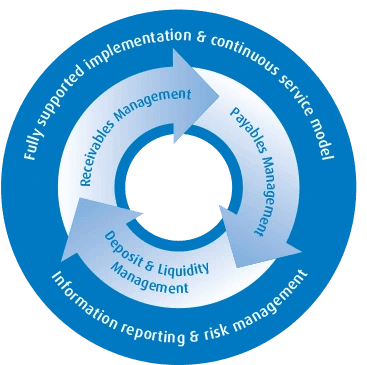
BMO’s strong Treasury & Payment Solutions (TPS) value proposition

Through continued investment in technology automation and AI, BMO TPS provides a robust scalable treasury management platform paired with efficient, cost effective delivery, while also helping reduce operational and fraud risks.
Because our treasury management experts are embedded within our Sponsor Finance team, we can quickly understand each company’s specific needs and tailor solutions that reflect both best practices and practical ways to improve day to day operations.
The benefits of a coordinated lending and treasury approach show up in very tangible ways, including:
Through a daily automated revolving sweep arrangement, BMO can directly connect a Company’s revolving line of credit with its BMO depository accounts, seamlessly enabling excess operating cash to pay down revolving loan outstandings every night (significantly reducing borrowing costs) while conversely providing overdraft protection in the case of deficient operating cash.
As a senior lender, BMO SF can provide streamlined approvals for treasury-related credit needs, including corporate cards. This integration also allows us to onboard add on acquisitions more quickly onto a combined treasury platform, helping Sponsors capture synergies sooner.
BMO SF provides comprehensive implementation support, along with resolute, responsive service for ongoing treasury management needs
Given the advantages of a fully integrated lending and treasury approach, many of our clients choose BMO for both financing and day to day cash management
BMO Sponsor Finance (BSF) has an unwavering commitment to core middle market lending despite private credit headlines
You cannot turn on the financial news without the pundits talking about private credit, an asset class that was rarely mentioned on these programs less than a year ago. Headlines related to private credit have included (i) decreasing information flow and controls on borrowers, (ii) artificial intelligence (“AI”) threats to software companies and (iii) suitability of private credit for retail investors.
Throughout all this, BMO has remained steadfast in its commitment to lending in this sector. The BSF team has been working together for over 20 years and has had a consistent presence in the core middle market long before the industry was referred to as private credit. While many of our competitors from the prior decade have moved up market seeking larger transactions to increase AUM more quickly, BMO has remained focused on expanding our share in the core middle market. Features of the core middle market which we think makes this market attractive include more frequent and detailed financial reporting and tighter credit agreements that limit cash flow leakage, meaningful debt incurrence outside the senior facilities and include financial performance covenants and, most importantly, the market still allows lenders to have closer relationships with borrowers and private equity owners.
The next issue to hit private credit was the AI’s threat of disruption to the software business model. Private credit lenders in the upper mid-market have much larger exposure to software borrowers. Tech focused PE firms have often tapped the private credit market for unrated, aggressive financing facilities to these businesses, many through recurring revenue-based structures when actual cash flow is not sufficient to justify the leverage provided. BSF has a well-balanced portfolio across industry sectors and software companies have a nominal percentage of our portfolio. Our portfolio has total software company exposure today of 4%, and our software borrowers have below average leverage and loan to value compared to the overall portfolio (sub 4x leverage and LTV below 30%). AI risk has been a key focus of our underwriting long before the AI risk hit the news cycle and we focus on technology businesses that have workflow entrenchment, proprietary data, and industry/regulatory complexity.
Lastly, on the increased redemption requests from retail investors, our private investors are long-term institutional investors. We have not focused on marketing our product at the retail level. In addition, BMO maintains a significant balance sheet investment in every transaction, creating significant alignment between BSF and our investors. On-demand liquidity for retail investors can create situations that impact the returns to the remaining investors. Despite the headlines, retail investors are estimated at only 15-25% of the overall market investor base. We see these headlines potentially halting the growth of retail investors but not having a long-lasting impact on the total market investor base.
While many of our competitors from the prior decade have moved up market seeking larger transaction to grow AUM more quickly, BMO has remained focused on expanding our share in the core middle market.
This publication was prepared by BMO Sponsor Finance (“BSF”), an affiliate of BMO Asset Management Corp. (“BAMC”), an SEC registered investment adviser. References to “investors” above include institutional investors in BSF programs that are not RIA advised and institutional investors in off balance sheet programs and accounts advised by BAMC. BSF does not provide investment advisory services. To the extent this material references BAMC advised strategies or investor participation, it constitutes an endorsement by BSF, which creates a potential conflict of interest.
A peek behind the curtain
A snapshot of BMO’s proprietary portfolio and transaction data.
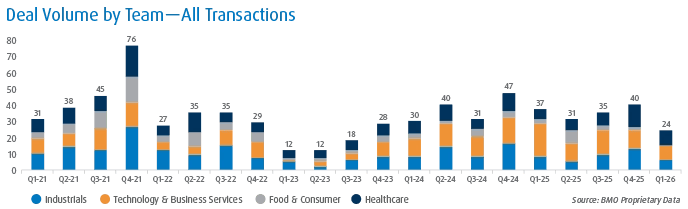
Quarterly transaction activity—all transactions
The overall portfolio remained active in Q1’26, with several platforms completing incremental financing for acquisitions across industry teams. Despite a slower new deal environment, existing platforms continue to execute on their M&A growth strategies, supported by lenders eager to deploy incremental capital for businesses and performing credits they know well.
While the fundamentals for a pickup in deal flow appeared strong heading into 2026, the emergence of global conflict created another cloud of uncertainty, resulting in muted activity in Q1. That said, there has been a notable increase in auction activity as we have moved into Q2, providing potential green shoots for the M&A environment despite the current macroeconomic backdrop.
Technology and business services remained the most active areas for new platform investments, with a focus on business models less likely to be disrupted by the increasing evolution of AI.
Pricing trends—all transactions
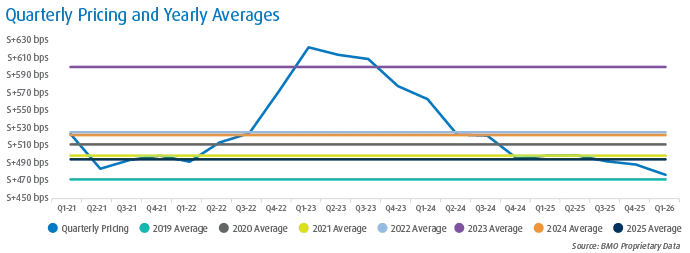
Competitive pressure for higher quality credits continued to drive pricing compression through most of Q1’26, which also resulted from the lighter transaction pipeline. There was no material movement in opening pricing, with most new transactions continuing to clear in the S+450-475bps range and upfront economics staying tight.
Towards the end of Q1’26, the global conflict added a layer of uncertainty, resulting in a dynamic of pricing discovery on active transactions. More recently, lenders have quoted an increase in spreads of 25-50bps depending on the transaction, though there continues to be more limited datapoints given a number of these deals have not yet closed. Despite this, the imbalance of supply (slower deal activity) and demand (ample dry powder from lenders and sponsors alike) persist, though overall activity has shown a modest pickup during the first few weeks of Q2’26.
Average total leverage trends—new LBOs
Leverage levels remained stable during Q1’26, with high-quality credits continuing to be supported by significant equity contributions from investors. Similarly, enterprise valuations have remained solid, as sponsors continue to lean in on attractive platforms and durable business models. Given the persistence of lighter auction activity, deals that ultimately close are typically competitive processes, further driving up enterprise valuations
