Transaction Trends provides private equity sponsors and investors with middle-market transaction information and insights compiled by the BMO Sponsor Finance group — information that helps sponsors and investors better understand the current financing climate in the middle market.
2026 Market outlook: themes, risks, and what we’re seeing and hearing
Following another tepid year in M&A in 2025, the tone of the market feels more grounded than it has in recent years as we step into 2026. While M&A activity remained subdued through 2025, the ingredients for a more active year are starting to fall into place. The early months may still be about preparation and some uncertainty, yet there is a growing sense and cautious optimism that the back half of the year could bring more meaningful movement.
Why the backdrop is improving
A handful of factors point to a better environment for improved activity than we have had over the last few years.
Rates are moving in the right direction. Since early 2024, benchmark short term rates have eased with the 3-month SOFR rate down 150 basis points. The absolute level still matters, but the direction has boosted confidence and strategic planning around exits.
Tax changes are more supportive of investment. The One Big Beautiful Bill Act restored more favorable treatment for capital expenditures and shifted interest deductibility back to an EBITDA basis. This combination improves after tax cash flow for leveraged businesses and, in turn, helps sponsors underwrite with greater clarity.
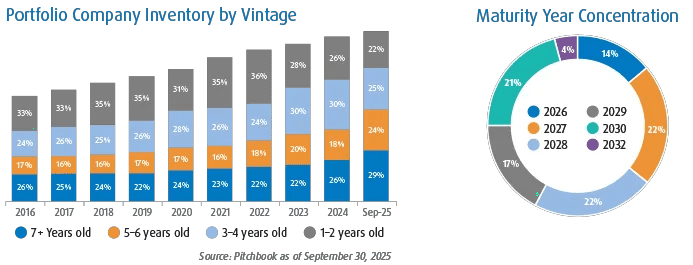
Aging vintages are coming due. More than half of PE backed companies (54%) are now five years or older. With standard fund timelines in mind, aging alone points to a larger wave of exits and recapitalizations. Secondaries have absorbed some of this pressure, but LPs are still seeking distributions so they can recommit to new funds. . That reality continues to influence fundraising and exit pacing, which has been tepid.
The maturity wall
There has been plenty of talk about a maturity wall. In practice, the past few years of add ons and targeted refinancings pushed many maturities out to the 2028 through 2030 window. This bought time but also created a need to execute and integrate these addons to maximize value. The net effect is a market that is better positioned to transact when valuations and timing return to alignment.
What we heard on the ground
Across recent industry conferences attended by our team, the tone was consistent: the market is finding its footing, but the rush is not here yet.
Deal flow remains thin in the near term. Most sponsors spent 2025 focused on portfolio work and rebuilding pipelines. The expectation is that the bulk of new deal activity skews to the mid to back half of 2026.
Exit pressure is rising, yet valuation gaps persist. LPs are pressing for realizations, but many sponsors expect to launch sale processes later in the year while sellers recalibrate expectations formed in earlier cycles. In select categories like Food & Consumer, scarcity has pushed valuations to the high end, at times above 20x EBITDA, which continues to limit buyer participation.
Sector focus is merging. In healthcare, interest in physician practice management (PPMs) has returned, particularly for specialty driven platforms with strong operations and technology enablement. Friction around multiples is still a headwind for new platform formation, so add on activity is doing more of the work. Other areas of interest include hospice, home & behavioral health, infusion, MedTech, and HCIT. Beyond healthcare, sponsors remain active in outsourced and professional services, where buy and build strategies continue to scale efficiently within fragmented subsectors. AI remains a cross cutting theme, improving productivity in services businesses while forcing a sharper view of defensibility in pure software. Furthermore, the buildout of data centers and the refocusing of federal spend and tariffs are drawing investment toward power & grid infrastructure, aerospace & defense, and engineered components tied to onshoring.
What this means for 2026
We expect a year that builds as it goes. Early 2026 is likely to be marked by pipeline preparation, and valuation discovery. Indeed, BMO Middle Market M&A reports robust pitch levels with a strong bent to Sponsor activity compared to prior years. As rate cuts filter through and sellers accept the new pricing reality, more processes should come to market.
For Sponsors, the playbook is straightforward. Stay ready, keep underwriting discipline, and focus on sectors with secular demand drivers. For management teams, it is a year to demonstrate strong market position and a credible path to multiple angles of growth. Those who do will meet a market that is increasingly willing to
transact, even if it still asks tough questions about price.
We’re the experts — continuation vehicle financing
In recent years, continuation vehicles (CVs) have surged in popularity. CVs can create liquidity challenges for GPs who must roll their equity into the CV and provide additional GP commitments alongside fresh investor capital. BMO Wealth Management has supported multiple sponsors in addressing these liquidity needs with solutions tailored to met both the upfront and ongoing financing needs of the General Partnership.
BMO Wealth Banking Solution
Existing GP holdings are often used as collateral to enable additional exposure to CV positions. This approach allows GPs to efficiently fund their commitments, manage cash flow across multiple fund cycles, and maintain the strategic flexibility needed to support ongoing investment activity and long term growth.
Case study

Sponsor. Mid-market PE sponsor with strong track record (Top-quartile; over $31Bn raised).
Transaction. Formation of a $1.0Bn Continuation Vehicle to acquire high-conviction assets from the sponsor’s prior flagship fund.
Rationale. Provide additional runway (3–5 years) to continue value creation plans, manage exit timing, and deliver liquidity to new and existing LPs through a structured process.
GP Commitment. 2.0% of Continuation Vehicle size ($20MM total).
Solution Proposed. Sponsor previously maintained a GP Loan Program with BMO to support general partner commitments across its most recent flagship fund. Additional capital was required for partners/employees to fund their incremental GP commitments to the CV. The BMO Private Equity Credit Team amended the existing GP Loan Program to include the new CV and expanded the facility accordingly.
BMO spotlight
Flawless BMO execution in complex, cross-border transaction.
BMO delivers an integrated, turn-key financing package in support of Vance Street Capital’s (“VSC”) acquisition of Damotech. The complex, cross-border nature of the transaction required a comprehensive solution that included transaction financing, foreign exchange, and fund financing solutions.
BMO Sponsor Finance (U.S.) and BMO Sponsor Finance (Canada) partnered with BMO Capital Markets and BMO Sponsor Fund Lending to ensure the seamless execution of a financing solution. The transaction highlights BMO’s ability to execute complex, multi-currency, cross-border financings in support of mid-market PE Sponsors — a unique, one-stop capability in the space.
Damotech, headquartered in Boisbriand, Quebec, is a manufacturer of aftermarket warehouse rack-safety solutions with operations across both Canada and the U.S.
Comprehensive, multi-disciplinary financing execution
BMO acted as Administrative Agent and Joint Lead Arranger, providing both U.S. and Canadian dollar term loans as well as a multi-currency revolver — executed in close collaboration between the U.S. and Canadian Sponsor Finance teams.
In addition, Sponsor Fund Lending delivered an upsize to VSC’s fund line facility, enabling the sponsor to bridge equity for a potential earnout, while the BMO FX Desk executed multiple USD/CAD transactions to ensure the sponsor had the appropriate currency to satisfy seller payments and retire existing indebtedness at close.
BMO reduces complexity and provides certainty of close
Seamless, coordinated closing across jurisdictions, products, and teams.
Cross-border structuring expertise — BMO delivered a coordinated U.S./Canada financing solution for both the seller payoff and new
financing structure.Financing structured to ensure appropriate go-forward operating capital in multiple currencies without the need for future FX transactions.
Certainty of execution — VSC relied on BMO’s ability to manage operational complexity and provide certainty of close.
Broader implications
The Damotech case illustrates the importance of working with financing partners who can bring experience and a comprehensive suite of capabilities to the most complex financing situations. When the transaction requires flawless execution and the simplification of complexity, BMO brings resources and expertise.

Damotech, headquartered in Boisbriand, Quebec, is a manufacturer of aftermarket warehouse rack-safety solutions with operations across both Canada and the U.S.
A peek behind the curtain
A snapshot of BMO’s proprietary portfolio and transaction data.
Quarterly transaction activity — all transactions
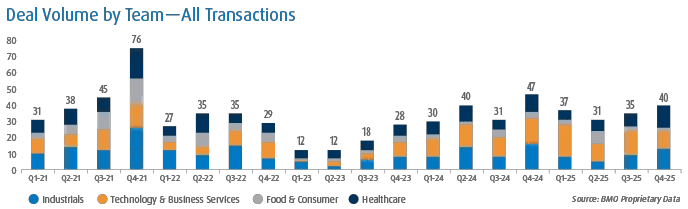
Overall transaction activity continued to build through Q4’25. Add on acquisitions, refinancings and recapitalizations all picked up as the year wound down, helped by a noticeable increase in portfolio M&A that re-accelerated in late 2025. Within BMO Sponsor Finance, total portfolio transaction volume in the second half of the year came in ~10% higher than in the first half, reflecting the steadier pacing of internal deal flow.
New platform activity, however, remained muted. LBO volume stayed limited in Q4 as valuation gaps persisted, and Sponsors remained selective about where to deploy capital. The combination of uneven pricing expectations and fewer high conviction opportunities kept platform formation subdued through year end. Several Sponsors indicated that they continue to evaluate opportunities but are waiting for more consistent alignment around valuation before leaning back into new platforms.
Looking ahead to 2026, the backdrop for deal flow appears more encouraging. A growing number of assets are approaching natural hold period maturity, and many Sponsors are beginning to acknowledge that valuations for certain companies are unlikely to return to the levels seen at close. That shift, combined with increasing LP pressure to deliver realizations, is expected to push more sale processes into the market during the second half of 2026. At the same time, an improving rate environment should help revive appetite for new platforms
as borrowing costs ease.Sector activity continued to show clear divergence. Technology and business services remained the most active areas for new platform investments, supported by their lower exposure to tariff concerns and the demand volatility that weighed on industrial and consumer facing sectors throughout 2025.
Looking ahead to 2026, the backdrop for deal flow appears more encouraging
Pricing trends — all transactions
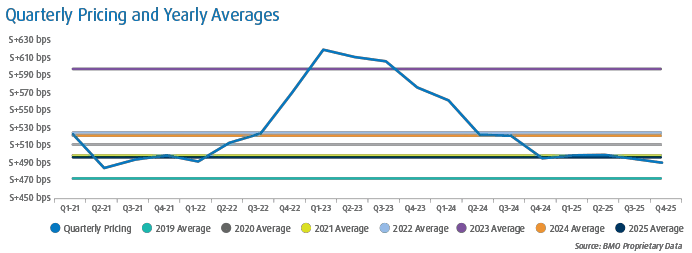
Competitive pressure for higher quality credits has driven continued pricing compression through Q4’25, though less pronounced in Q4 than in Q3. Most new transactions have continued to clear in the S+450-475bps range. Up-front economics remain tight, which is reflective of both lower deal flow in the direct lending market as well as the broadly syndicated market, underscoring borrower-friendly dynamics.
Abundant dry powder across direct lenders in a muted M&A environment continues to compress economics.
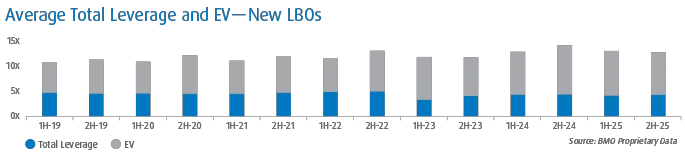
Average total leverage trends — new LBOs
Leverage levels remain disciplined and below prior cycle peaks, despite fluctuations increases, averaging around 4.3x throughout FY25, reflecting a market anchored by higher equity contributions and selective lender underwriting. Lenders continue to lean in on high quality credits where enterprise value durability, cash flow resilience, and margin stability provide strong downside protection, even as competitive pressure persists. While sponsors continue to favor senior only structures — representing 85% of BMO SF’s FY25 new platform closings — capital deployment remains measured, with leverage constrained by a structurally higher cost of capital and a continued focus on sustainable credit fundamentals.