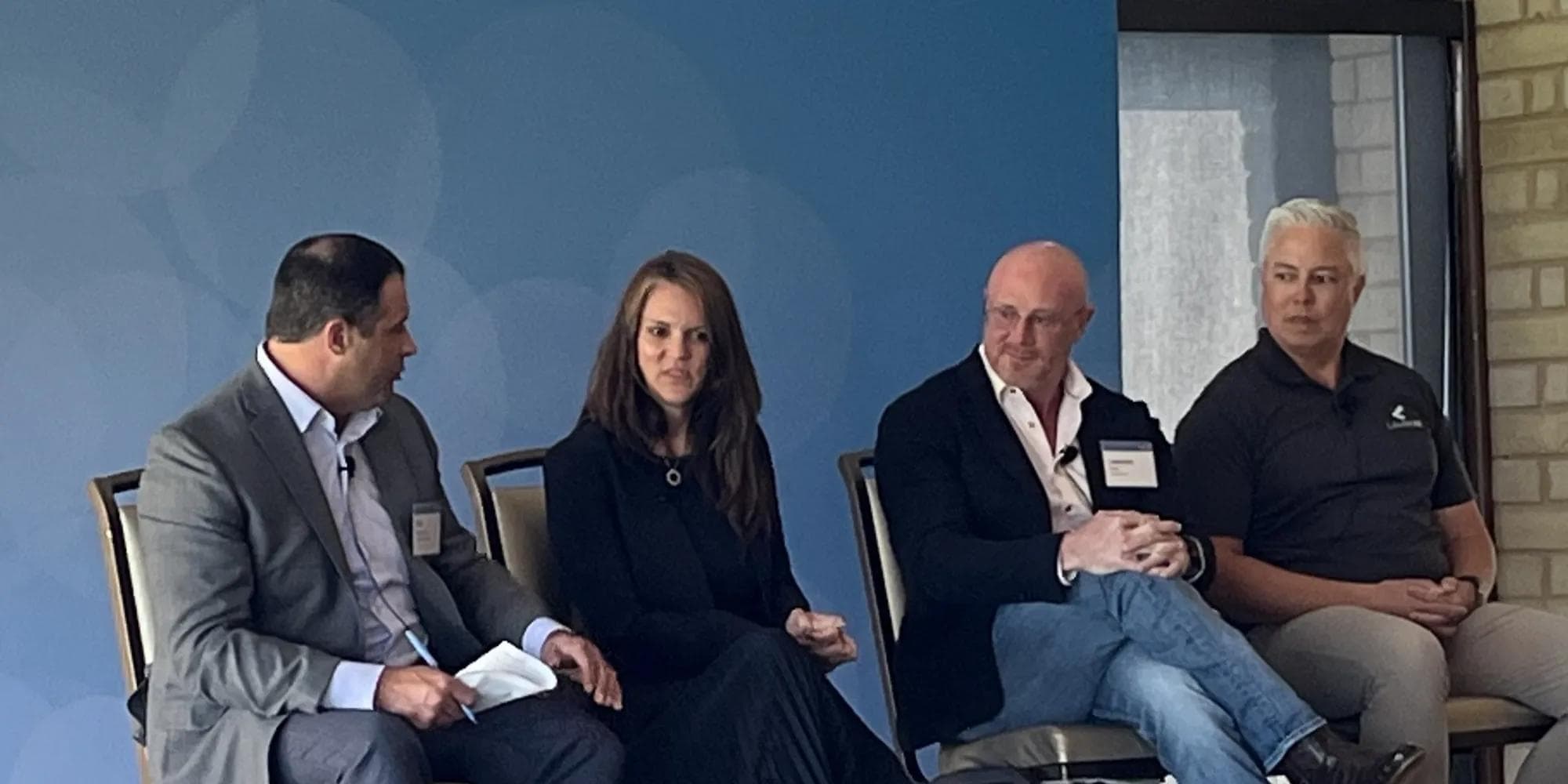
Artificial intelligence (AI) is rapidly becoming an integral part of many companies’ day-to-day operations. We recently held an event in Dallas to help businesses get a sense of why some AI projects succeed while others fail, and to share best practices for successful implementation.
Nick Salomone, Texas Region Head, BMO Commercial Bank, moderated a panel discussion with three experts who shared their insights:
Kristin Milchanowski, Chief AI and Data Officer, BMO
Lawrence King, Founder and CEO, Headstorm
Andrew Louder, Founder and CEO, Louder AI

Keys to success
Since ChatGPT burst on the scene in 2022, companies have accepted that AI is a game-changer. But according to a recent MIT Media Lab/Project NANDA report, 95% of generative AI pilot programs fail to generate any return on investment.
From the perspective of BMO’s AI journey, Milchanowski said calculating the ROI up front is essential. “My team will not accept a project if it's not going to deliver one basis point to the enterprise, period,” she said. “I start with a value and it's either going to drive revenue up one basis point or it's going to drive out costs one basis point.”
Louder cited a few reasons that many AI pilots fail. "Often, it's a lack of strategy, poor execution and not enough intention in the training being provided to drive adoption. There are plenty of applications out there that can benefit every company of all sizes. It's just a matter of having a sound approach, starting small, driving success forward and starting to get the ROI back right away.”
To that end, King said the companies that succeed are the ones that use AI for automating specific tasks as opposed to tackling more mission-critical systems. “We like to talk about this in terms of soft-edge problems versus hard-edge problems,” he said. “Soft-edge problems are things where the AI can be 80% to 90% right, but there's still value in delivering that. As opposed to hard-edge problems, like managing air traffic control, where there's not much forgiveness.”
King added that the companies that have successfully implemented AI have first considered it at the strategy level. “They're thinking through how they solicit use cases from their business functions or their business lines,” King said. “Do they have a rigorous process around that? How are they evaluating those use cases? They're creating a backlog of these AI use cases and have a cross-functional team that is part of a committee that manages this backlog. And the backlog gets prioritized from the highest outcome-based use cases. The companies that are following this methodology are succeeding at almost double or triple the rate of companies that are tackling it with an ad hoc approach.”
King said those use case backlogs are critical because AI is advancing so quickly. He recommended building a cross-functional team to solicit input on potential opportunities for AI implementation.
"Those use cases may be hard-edged problems that are challenging to solve right now, but this technology is changing extremely fast—every three months,” King said. “So, having that in the backlog is an important piece of the rigor and process investing up front. It's important to fail at these things. Not all of these are going to work. But having that rigor in place is what’s important.”
An AI success story
Louder explained what drove a successful AI implementation for one of his clients, a pharmaceutical distributor that wanted to use generative AI to improve productivity. Louder AI identified the appropriate use cases that would benefit each group and established a training program. Louder also conducted pre- and post-productivity surveys for each group.
“Their people were saving about 10 to 12 hours per user per week,” Louder said. “That’s 80,000 hours per year, or about $4 million worth of productivity value, back to the bottom line. That's massive. And why were they successful? They assigned a project manager to work with us directly. They gave her the time to drive intention behind all this work that we were doing. Their CEO had a vision in place to drive it forward. And because they spent the time progressing through it, they're now at a place where they're implementing autonomous AI agents.”
Designing AI with empathy
While AI promises to be a revolutionary technology, it’s your workforce that determines how successful it is. Milchanowski noted that her team makes it a point to design any AI program with empathy. “You can't build trust in an organization unless you design it with empathy up front and really understand the nuances of the human components along the way,” she said.
Milchanowski commented that, “innovation without empathy is empty,” a sentiment that King agreed with as he outlined a few questions organizations should ask before embarking on any AI project.
“How are my users going to use this?” King said. “Is it valuable to them? How are we putting diagnostics around that? It's going to be driven by adoption. There has to be some change in the organization to get everyone to understand what's coming and get everybody rowing in the same direction.”
Given the speed with which AI is evolving, getting that organizational buy-in grows more critical by the day.
“AI is a freight train,” Louder said. “It's just a matter of where you're going to get on that freight train, especially relative to your competition. The sooner you can get on it, the further along you're going to get, and the further along you're going to be reaping those benefits. Hopefully, you can get on that train now and do this thing the right way.”