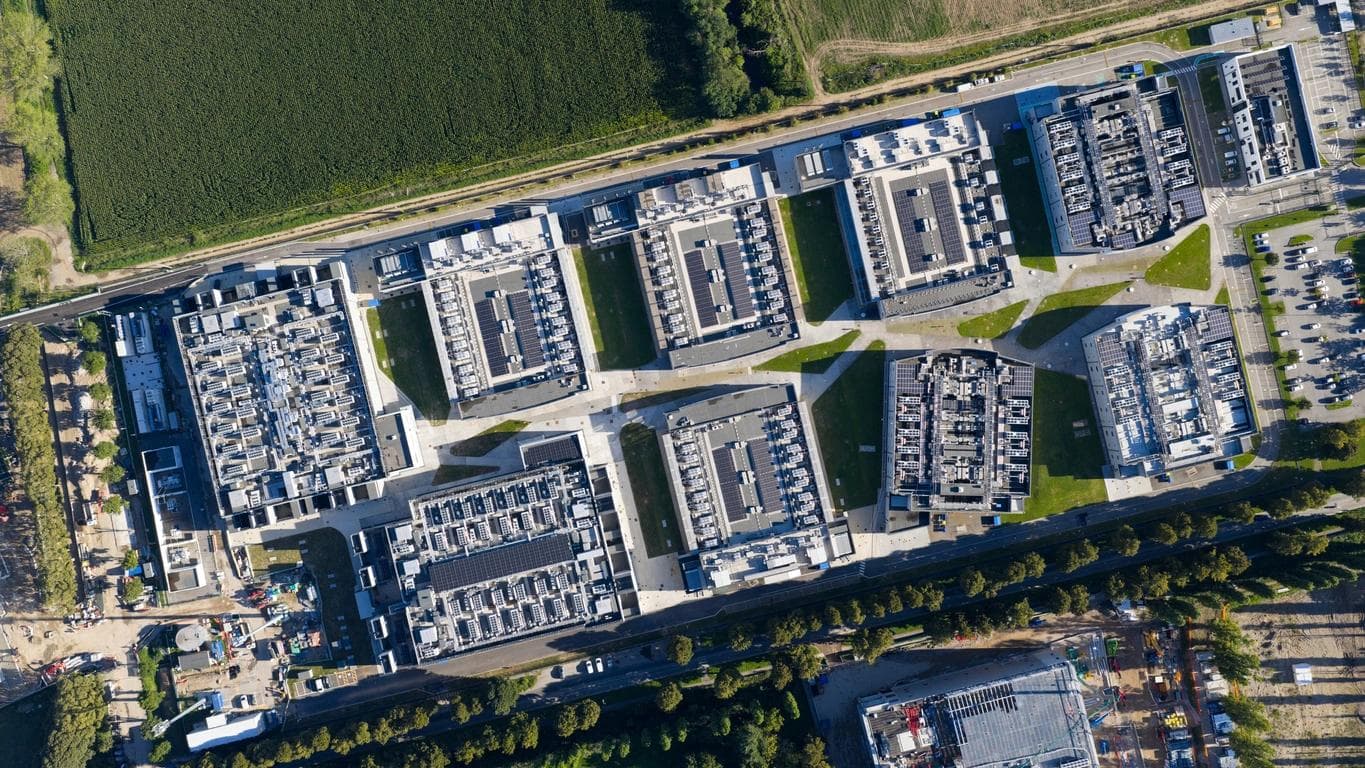


Data center construction is booming across the country. Thanks to the artificial intelligence revolution, monthly spending on these projects in June rose 7% to $68.3 billion, according to the Census Bureau. Even more impressive, that represents a 46% hike year-over-year.
It’s a boost the industry needs. While spending on other non-residential and manufacturing construction projects are flat or declining, AI data centers currently account for 59% of private office construction. Accordingly, contractors are looking to capitalize on the demand. But there are several considerations to take into account.
Data centers are massive, multiyear projects that come with significant logistical and risk management demands. Here are some of the tactics we’ve seen successful firms putting in play.
Mobilizing quickly
The AI data center boom is driven by hyperscalers—the large-scale cloud computing providers that require millions of servers (Microsoft, Oracle, Amazon, and Google are well-known examples). They’re expected to spend more than $785 billion on AI infrastructure in 2026 and $1 trillion in 2027.
The market leaders have established mission-critical teams with dedicated preconstruction, engineering, procurement, commissioning, and operations expertise. This allows them to respond to hyperscalers much faster than traditional commercial builders.
The winning firms are also establishing local offices and networks in advance in the markets experiencing the most rapid growth in data center projects, such as northern Virginia, Texas, Georgia, and Utah. We’ve seen some of the larger general contractors establish new teams in central Ohio to be ready for opportunities from hyperscalers that had already made commitments to build data centers there.
Tactical shifts
Because hyperscalers need to move quickly to meet the ever-increasing demand for AI infrastructure, construction schedules for data centers are heavily compressed compared with typical commercial projects. In response, we’re seeing firms invest in prefabrication on both the electrical and mechanical sides. They’re also securing equipment early because lead times are growing for items such as generators, transformers, and cooling equipment. These tactics often require establishing a procurement team that is dedicated to mission-critical projects only.
This approach comes with some risks. In a sector that is moving so quickly, and with project delays impacting certain regions, prefabrication can leave a firm exposed to expensive rework, scrapped inventory, delays, and schedule disruptions. To mitigate these risks, contractors are using standardized designs, locking in design decisions earlier, engaging owners early, and building systems that allow flexibility if needed.
On the financial side, mitigation can include negotiating cancellation rights, securing owner approvals, and procuring equipment only after key milestones have been met.
Meeting the labor demand
Data center developers are willing to pay a premium for construction wages, around 30% according to some estimates. The premium reflects strong demand for specialized construction skills amid an industry-wide shortage of qualified workers. That’s why we’re seeing contractors expand their craft recruitment programs, create regional labor pools, secure long-term subcontractor relationships, self-perform more work, and develop apprenticeship and training pipelines specifically for these projects.
These tactics won’t necessarily solve near-term shortages. But given the outlook for data center construction, these investments should pay off in the long run.
Playing it smart
Perhaps the biggest risk facing contractors is the impulse to throw all its eggs into the data center basket. Fortunately, many firms have told us that they’re capping their total data center exposure to a level they’re comfortable with to maintain project diversity.
Some contractors are using the data center boom as an opportunity to explore other sectors that other contractors are deprioritizing. For example, we’ve seen contractors move their top teams to more traditional sectors, such as manufacturing, life sciences, or healthcare, when a competitor shifts its top talent to data centers.
All signs point to data center construction continuing to grow. So will the opportunities for contractors prepared to handle the increased complexity that comes with these projects.