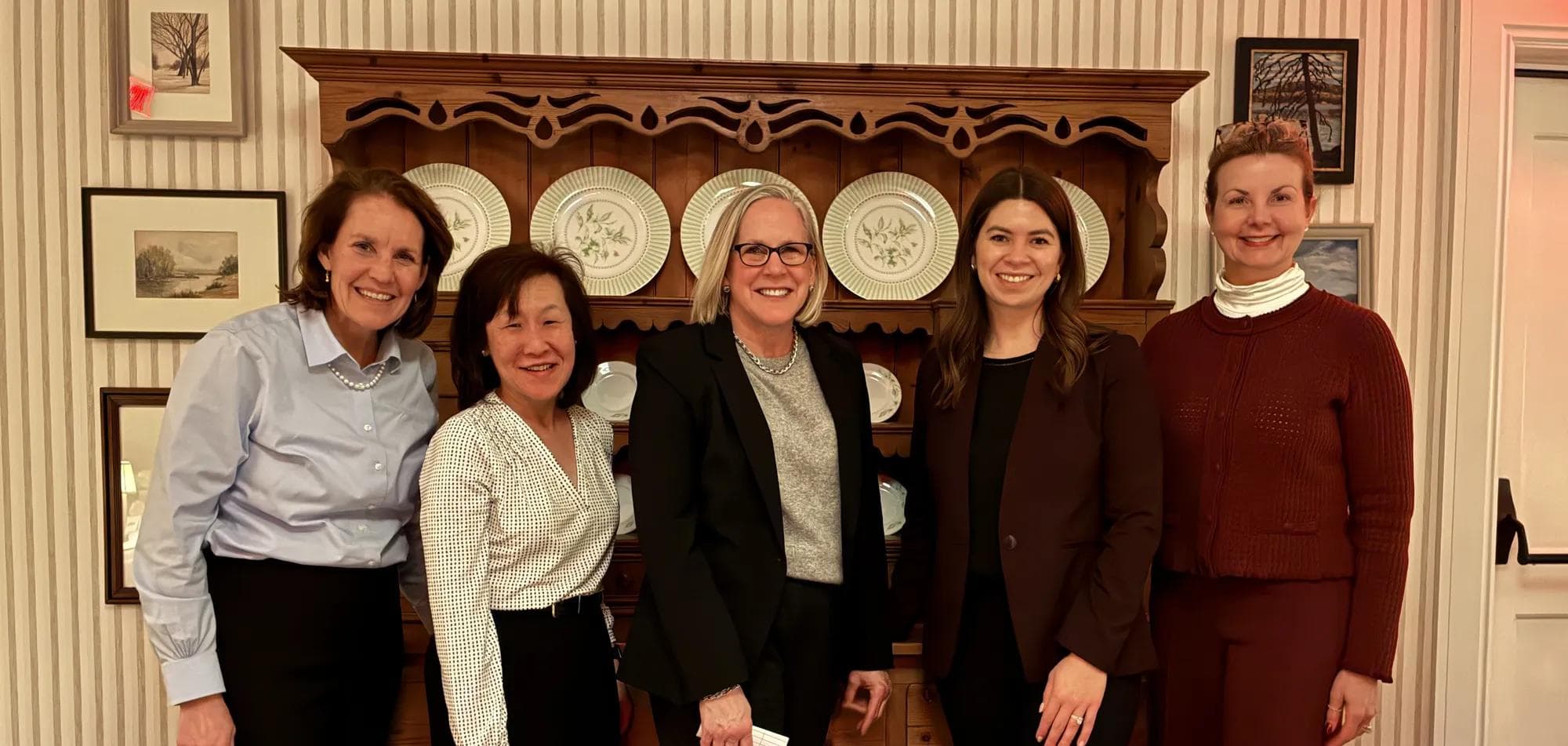
BMO’s “Beyond the Bottom Line” series focuses on personal planning opportunities for business owners and C-suite leaders. As part of Women’s History Month, our most recent event focused on business succession planning.
BMO’s research has found that while more than half of male business owners have a detailed transition plan in place, only one‑third of women do. And many women tell us they feel less confident navigating these financial decisions.
But here’s the inspiring part: when women engage advisors and start planning early, their confidence rises, their options expand, and the outcomes—for themselves, their teams, and their communities—become dramatically stronger.
During the event, I was able to dive deeper into this topic with three speakers who had their own take on succession planning based on their experiences:

Stacey Walthers Naffah, President and CEO, Wm. K. Walthers, shared insights from her company’s transition experience
Rebecca Hulce, Vice President and Senior Wealth Planning Strategist, BMO Wealth Management, discussed estate planning techniques that create financial clarity, continuity, and long‑term security
Ashley Kirchner, Director of Corporate Advisory, BMO Commercial Bank, outlined the considerations involved in selling your business outright
The following is a summary of the event.
A case study in family succession
Wm. K. Walthers is a fourth-generation family owned and operated manufacturer and distributor of model railroad supplies and tools. After embarking on her own career in marketing and advertising, Stacy Walthers-Naffah succeeded her father Phil Walthers as president in 2018. Family succession has been part of the company’s strategy.
“It’s been intentionally done in a way that’s consistent with best practices in family businesses,” she said. “We have looked to best practices and external guidance in every generation. Generation two, my grandfather, recognized the value of this effort, and that’s truly in the ethos of our company – to look outward to learn what works best for businesses in general, to family businesses, and apply those principles inside our own business. Ownership and leadership of a family business requires a special level of care to achieve a critical success metric that can often overlooked, family harmony.”
Naffah returned to the family business in 2009 after her solo career, which she believes makes for a more effective succession. “One of the best practices in family businesses is to go work somewhere else,” Naffah said. “I did not think I was going to do this. This was not a linear path. I did not know I was going to come back to the family business. But the door was open.”
Part of the succession guidelines the company established is to maintain family harmony. “Doing that with intention is part of the framework,” Naffah said. "That means you don't just get a job because you are a family member. You get a job because there is a job available, you're qualified, and because you are interested in working there. I was exposed to the business, but I was never forced to do it; it was never an expectation. When I came back, I came back because I wanted to and because I had experience that could be applied to support a need at the company.”
Naffah noted that while a longstanding framework has been in place, it’s important to update it to the business’ current needs. “I think having an external advisory board is key. My grandfather had an external advisory board when that was less common to do so. My dad carried on that tradition and created his board based on the three pillars that were necessary to grow the business at the time. The business today realizes the value of continuity of our external board members who have been with us for many years and I have worked to evolve the board to address key needs of the business that exist today. I added somebody in IT infrastructure, and I'll continue to look to evolve how the board supports the business needs over time.”
While Naffah is laser-focused on growing the business and feels that the transition her and her father made from generation three to four was very smooth, she realizes she needs to move forward with an eye on the next step. “You’ve got to run the business like you want to run it forever, and that's been my primary focus,” she said. “But now I have 21- and 19-year-old kids, and I'm sitting on top of having to figure this out for the next generation. Now I have to get busy on how this integrates with the company’s forward looking strategic plan, my succession plan, and my family’s estate plan. The best practices and thoughtful approach we pursued in the past will guide my efforts with confidence – always keeping family harmony front and center.”
Succession strategies
BMO Wealth Management’s Senior Wealth Planning Strategist Rebecca Hulce focused on two succession pathways that require careful, proactive planning: transitioning a business within a family, and transitions involving business partners. Establishing expectations early, as in Wm. K. Walther’s example, is key.
“It’s laying out the structure first; you have to know what you want,” she said. “I've heard stories before about how it doesn't end up the way people think it's going to end up sometimes. Change occurs; health and life events occur. But the early stage involves really understanding your desired goal. The early steps have to plan out whether you want this business to transition within your family or not.”
Whether the goal is to preserve ownership across generations or ensure stability among partners, the right structures can make all the difference. “That's where the tax-planning strategies come in, and they can be very different,” Hulce said. “Are you transitioning it to that next generation? Or are you transitioning to a nonfamily entity?”
Hulce outlined some of the techniques available, such as a family limited partnership, a grantor retained annuity trust (typically used in family succession), and a buy-sell agreement (typically used when selling to a third party). Whichever option you choose, Hulce said business owners should make adjustments to those documents over time to ensure they align with your estate planning goals.
“Time comes in on so many different elements,” Hulce said. “Time comes in on the tax-planning side. It comes through on getting that first generation accustomed to the concept of giving up control and stepping away at some point. There can be an urgent health event or a death, and you think you’ve got that structure in place. But all of a sudden, a tragedy occurs. When it comes to having a plan in place, the sooner the better. And even if you have to change it a few times along the way, that’s better than having no plan in place whatsoever.”
Considerations for an outright sale
Ashley Kirchner of BMO Commercial Bank’s Corporate Advisory team closed the event with a discussion on what it takes to execute a successful sale. She noted that detailed preparation can help provide flexibility and optionality regarding when you sell, how you sell, and who you sell to. She also pointed to one factor in particular that can boost a company’s attractiveness to buyers and, ultimately, its valuation.
"One of the successful pieces [to a successful sale] is professionalizing the business years in advance of a sale,” Kirchner said. "Your management team is critical. If you’re on the third or fourth generation, and you've realized that there is not a next generation ready to step in, what does your leadership team look like? Oftentimes in the companies we work with, ownership is management, and the day you're ready to exit, who's going to continue to run that business on a go-forward basis? In that sense, your internal options become more limited, and any strategic or private equity buyer is going to be keenly focused on what the strength of that team is.”
The quality of your financial statements is another crucial factor. “How robust is your internal reporting?” Kirchner said. “Are you getting compilations with your accounting firm today? Are you getting reviewed or audited statements? They're not necessary, but when you're going to market, that robustness in financial reporting does make a difference.”
Kirchner added that owners should be focused on these and other factors years in advance. Treating a possible sale as a long-term strategy will help boost your company’s value in the end.
Whether you sell to a strategic buyer (often an industry competitor) or a financial buyer (private equity firm, family office), owners will ultimately have to consider the personal side of a sale. Kircher said it involves asking yourself questions that can be difficult to answer, including:
Are you ready?
What does retirement look like for you?
What does it mean for your family?
It’s also essential to consult with your wealth advisors to determine the amount you’ll need to live the life you want postsale. "You've been building and generating wealth from your business your entire career, and now you have to think about living off that,” Kirchner said. “How do you go about investing and putting together the plan so that you have confidence going in.”
To prepare for an outright sale, bring in an M&A advisor, tax specialist, and wealth manager early to help determine optimal process timing and individual financial strategies. When selling outright, hiring an advisor can help owners maximize value by running a competitive process, accessing more qualified buyers, and negotiating more effectively to improve total proceeds and terms. Through the performance of a Quality of Earnings before going to market, determining normalized earnings and EBITDA add-backs is recommended and can prevent issues on the back end.
This event continued a tradition that reflects BMO’s longstanding commitment to advancing women leaders, entrepreneurs, innovators, and changemakers across North America. This year is particularly meaningful as we celebrate the 10th anniversary of BMO for Women. For a decade, this initiative has been dedicated to supporting women entrepreneurs, investors, and leaders—meeting them where they are and helping accelerate their success. Because when women have strong succession plans, they not only strengthen their own organizations, they also pave the way for the next generation of leaders.