Structural shifts in the wine industry, from evolving consumer preferences to margin pressures, are increasing the need for a financial partner that can help navigate these dynamics. As the third annual BMO 2026 Wine Market Report makes clear, historic changes in consumer demographics will likely reshape the industry. That’s one of the challenges the industry currently faces.
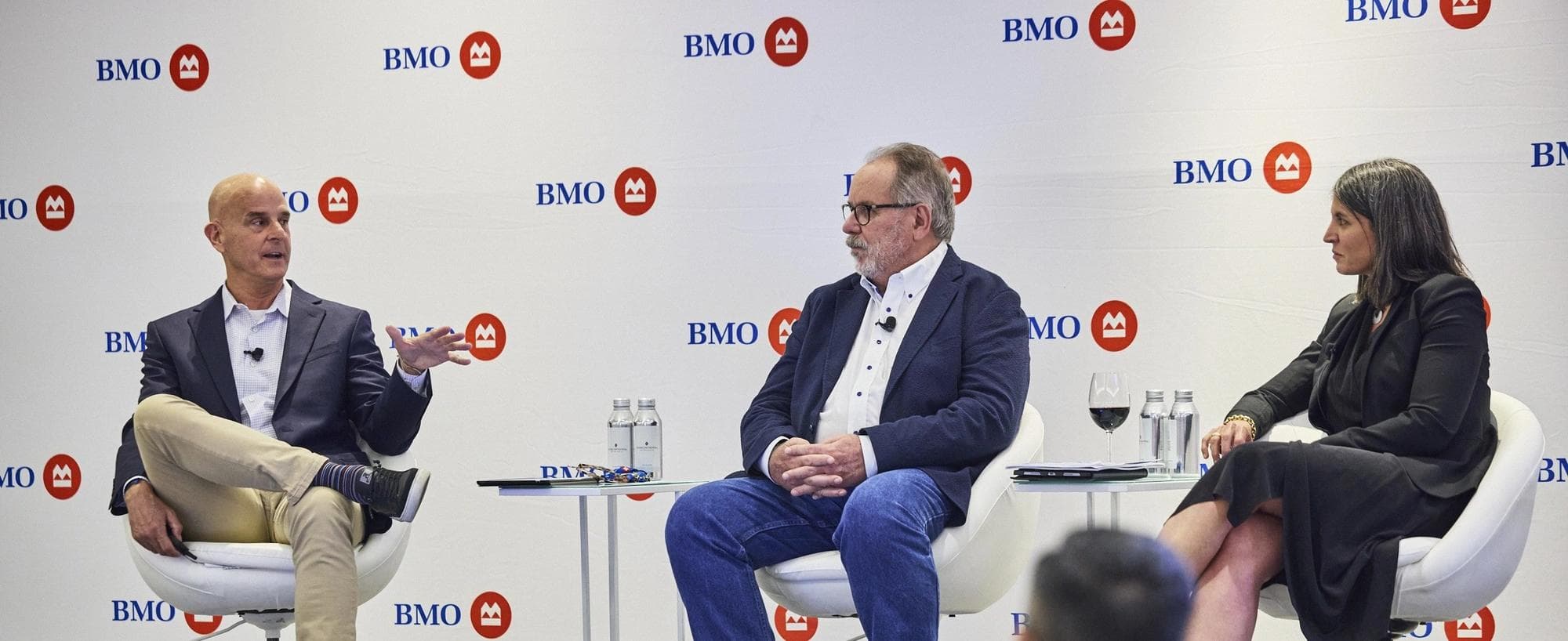
Navigating this environment requires solid, clear data to help producers make good decisions. To help make sense of what’s happening and where the industry may be heading, a panel discussion was hosted at the 21st Annual BMO Farm to Market | Chemicals Conference in New York. The industry experts who joined this discussion were:

Adam Beak, Head, Beverage, BMO Commercial Bank
Francesca Guidi, Managing Director, Beverage, BMO Commercial Bank
Jon Moramarco, Managing Partner, bw166, an alcohol industry market intelligence firm
Here is a summary of the insights.
Market overview: The second downturn
As Moramarco noted, the industry is experiencing just its second downturn since the repeal of Prohibition. This cycle is being shaped by a combination of demographic shifts, evolving health considerations, including the rise of GLP-1 and other weight-loss drugs, and increased competition for discretionary spending.
“If you go back to ’93, there weren’t that many beverage types to go to,” Moramarco said. “Today, we’re losing consumers to cannabis, we’re losing people to alternative beverages. Online betting is popular among younger people. The money is going there rather than alcohol.”
Those trends show up in the data. Total market volume in 2025 was 362 million cases, which represents a 4% decline year-over-year, and a 12% drop from 2018. That’s despite total spending growth of 3% for the year.
While the environment remains challenging, Moramarco pointed to a bright spot in the 2026 Wine Market Report: roughly one-third of wineries are still achieving growth. “No matter what’s happening in the world, there are ways to win,” he said.
That growth is increasingly concentrated among wineries that are adapting their go-to-market approach, targeting new consumer segments and evolving how they price and position their products.
The panelists also pointed to emerging areas of strength, including private label production and evolving product formats, which are helping smaller wineries access new channels.
In addition, there’s an imbalance between distributors and suppliers. Guidi explained that as the number of distributors has declined sharply through consolidation, the number of wineries has exploded.
“We’re selling the same volume of wine as we did in 2012, yet there are 50% more wineries,” she said.
However, this is not a uniform downturn. There are still areas of growth and opportunity depending on strategy and positioning.
Margin pressures
While the wine industry’s total market value is growing, more businesses are experiencing sales declines. Much of the consumer spending is captured at retailers, restaurants, and wholesalers. As Guidi pointed out, that’s shrinking producers’ margins.
Another factor is the emergence of private label wines. Guidi noted that more producers are creating exclusive brands for retailers such as Costco, Trader Joe’s, and Aldi. While that’s a positive development for retailers (who receive higher margins) and consumers (who get wine at affordable prices), it puts pressure on producers.
“Even the smaller producers that have not tapped into those channels historically are getting into those markets,” Guidi said. “If you think about the market growing by 4% and then private label is growing exponentially beyond that, that means traditional branded sales are declining, which means lower margins and less value to the producers. So, it makes it a difficult environment for them.”
The post-pandemic decline in direct-to-consumer (DTC) sales is also a factor. “People are dropping their wine club memberships,” Guidi said. “A lot of that has to do with the baby boomer population, who were big collectors and wine club members. They’re drinking less, their cellars are full, and they’re canceling their memberships.”
Despite these pressures, wineries are actively adjusting how they operate, reassessing pricing strategies, exploring new distribution channels, and strengthening direct relationships with their customers to remain competitive. This includes:
Expanding into private label partnerships
Reassessing channel mix (DTC vs wholesale)
Focusing on cost discipline and pricing strategy
Navigating consumer shifts
Both older and younger consumers are drinking less.
“One of the key problems is that we built a business on baby boomers,” he said. “We didn’t think about the diversity of younger consumers. We premiumized the business, and it’s harder for entry-level consumers to drive at higher price points. In some respects, wine is looked at as a special occasion, luxury beverage.”
The age 21-to-25 demographic also reports drinking less than they did a decade ago. Given that people tend to age into becoming wine drinkers, that presents a potential long-term challenge for the wine industry.
While younger consumers are engaging differently with wine, the opportunity remains to capture interest through more accessible positioning and evolving product formats. Wineries that can simplify messaging, expand accessibility, and better align with changing preferences are more likely to capture this next generation of demand.
While the industry is navigating a period of change, companies that are proactively refining their pricing, go-to-market strategy, and customer engagement approach will be better positioned for long-term success.
About the 2026 BMO Wine Market Report
This is the third edition of the report, which uniquely bridges proprietary industry data with in-depth wine-sector insights. This year’s study focuses on the rapidly changing U.S. wine market, still the world’s largest, but one that has declined in overall volume in recent years.
Despite these headwinds, wineries remain cautiously optimistic about the future. 71% of wineries surveyed expect the U.S. wine industry to stabilize or rebound within the next three years, with 38% believing a turnaround could come sooner – even as many acknowledge that the next phase of growth will look very different from the last.
The 2026 edition also reflects the continued evolution of BMO’s Wine Partnership, with the addition of Baker Tilly alongside WineBusiness Analytics and bw166. Together, the partnership brings economic, operational and survey-based insights into a single, comprehensive view of the U.S. wine market, at a time when demographic shifts, pricing pressure, distribution disruption and changing consumer behavior are reshaping the industry.