
Public sector and Indigenous organizations are experiencing change including rapid technology advancements, fiscal pressures, and an evolving policy landscape. Navigating this new paradigm requires adopting integrated strategies that address these forces.
The theme of BMO’s 4th Annual BC Public Sector Symposium was “Banking on the Future Across Digital, Economic, and Political Change.” Senior leaders across municipalities, health authorities, post-secondary institutions, and Indigenous organizations gathered in Vancouver to network and exchange ideas. Attendees were treated to a series of panel discussions that provided practical perspectives on:
Artificial intelligence
Digitization tools and solutions
Navigating the economic outlook and budgetary impacts

Bernardo Arreaga, Managing Director, Public Sector and Indigenous Sector, BMO Commercial Bank, Canada, served as emcee for the event. Together, Arreaga and Charles Matu, Director, Treasury & Payment Solutions, have been instrumental in shaping the BC Public Sector Symposium into a premier forum for collaboration and thought leadership. “As a trusted advisor to the public sector and Indigenous sector, BMO is proud to host the fourth and largest edition of our BC Public Sector Symposium to date,” Arreaga said.
The following is a summary of the event.
Artificial intelligence
When it comes to AI, the private sector’s main concerns are driving revenue, creating efficiencies, and maximizing their return on investment. Public and Indigenous sector organizations, on the other hand, view AI through the lens of maximizing community value.

Moderated by Greg Vriend, Senior Vice President and Head, BC & Yukon Region, BMO Commercial Bank, Canada, much of the conversation focused on the human side of AI. Larissa Chaikowsky, BMO’s Chief Learning Officer and Head of Talent and Culture Enablement, emphasized that AI is not a replacement for human judgment. That’s especially crucial for organizations that serve the public, which emphasize establishing trust with the public.
“AI is great at processing data, but judgment requires context and building trust,” Chaikowsky said. “If I were to draw a parallel between BMO and the public sector, one of the things that we have in common is that we're trusted organizations, and it's very easy to break that trust. AI helps, but it doesn't make it happen.”
Maintaining that trust requires transparency around how your organization is using AI, including where the information is stored and how it is secured. Kiran Konanur, Managing Director and Partner of Boston Consulting Group's Financial Institutions practice, said adhering to Canada’s data residency requirements for public sector AI is paramount. “The data has to stay in Canada,” he said. “From there, you need to be transparent about where the data goes and what infrastructure it’s hosted on.”
Also crucial is transparency around data assurance—that is, the use and intended purpose for the data that you're collecting and processing, and how you're using the insights from that data. The third piece is human accountability. “In the end, the AI tools enable you to make smarter, faster decisions, but the decisions lie with the people,” Konanur said. “That's what matters. That's where you drive accountability.”
As for functional use cases, AI-driven cash forecasting and other finance department tasks are becoming valuable tools for organizations, according to Souvik Adhya, Chief Data, Analytics, and AI Officer, BMO Commercial Bank, Canada.
“The true power of AI is the ability to mine through patterns and vast amounts of data much better than any human can do, and to bring those insights to the surface,” Adhya said. “We’re already seeing accounts payable and invoice processing implemented at scale in the public sector.”
But, as Adhya explained, the promise of AI can only be realized if organizations create a culture of experimentation. “The best thing we can do is to create the environment and psychological safety for our teams to use the tools and learn from it,” he said. Adhya emphasized that when teams are encouraged to share knowledge and accept some amount of tactical failure, AI can be more effectively scaled across organizations. That will ultimately be what separates organizations that generate value for their customers and those simply trying to keep up with the pace of adoption.
Digitization tools and solutions
Digitization is more relevant than ever in the context of trade headwinds, tariffs, inflation, and other factors that make budgeting, financial forecasting, and risk management more challenging. Justin Boisvert, Head of Treasury & Payments Solutions Sales, BMO Commercial Bank, Canada led a discussion that outlined the tactical ways organizations can align digital innovation with institutional change.

Ryan Kinghorn, Senior Optimization Consultant, Treasury & Payments Solutions, BMO Commercial Bank, Canada, frequently helps public sector and Indigenous organizations improve their cash flow processes. He understands that with budget constraints, organizations tend to squeeze every bit out of the legacy systems they have in place. But the tide is turning as finance departments understand the need to transition to more innovative tools to help lower costs and improve fraud protection, among other benefits.
"Invoice receipt and reconciliation tend to be laggards as far as adopting tools and digitizing that process,” Kinghorn said. "That can have a big impact on how quickly you can be ready to pay. There are a lot of tools that deploy AI to help expedite the matching process.”
Mastercard has a global view on payment trends. Peter Barnett, Vice President, Commercial Services, Mastercard Canada noted that working capital optimization is the leading factor on the minds of CEOs and finance executives. One solution has been the use of virtual cards.
“Organizations can now identify which of their vendors they can drive to a corporate card, incorporate that into an AP buyer-supplier relationship, and use a virtual card or a tokenized payment to make that payment,” Barnett said. “It makes the payment digital. Also, all the information that you want to include with that payment is attached to that tokenized payment—purchase order information, date ranges, amounts, vendors, right down to the specific vendor that you want to use the payment for.”
Several innovative capabilities are emerging in the market that promise to benefit public sector and Indigenous organizations. Dan Jansen, Head of North American Payables, BMO Commercial Bank, highlighted faster, data-rich payments. “Payments can be fast, but they are meaningless without data” he said. “In some of the legacy services like electronic funds transfers, there's very limited data, and that makes it hard for reconciliation and manual investigations. It also makes it harder to capture fraud. We're seeing a shift in organizations using Interac e-Transfer, which is typically thought of as a retail payment, but we're seeing more and more adoption by our commercial and government entities.”
Navigating the economic outlook and budgetary impacts
From interest rates to policy shifts to tariffs, there’s plenty of news that impacts municipalities and the Indigenous sector. The key for organization leaders is to cut through the noise and focus on what can help you drive decisions from a budget perspective. The discussion explored the current economic environment and its implications for organizations.
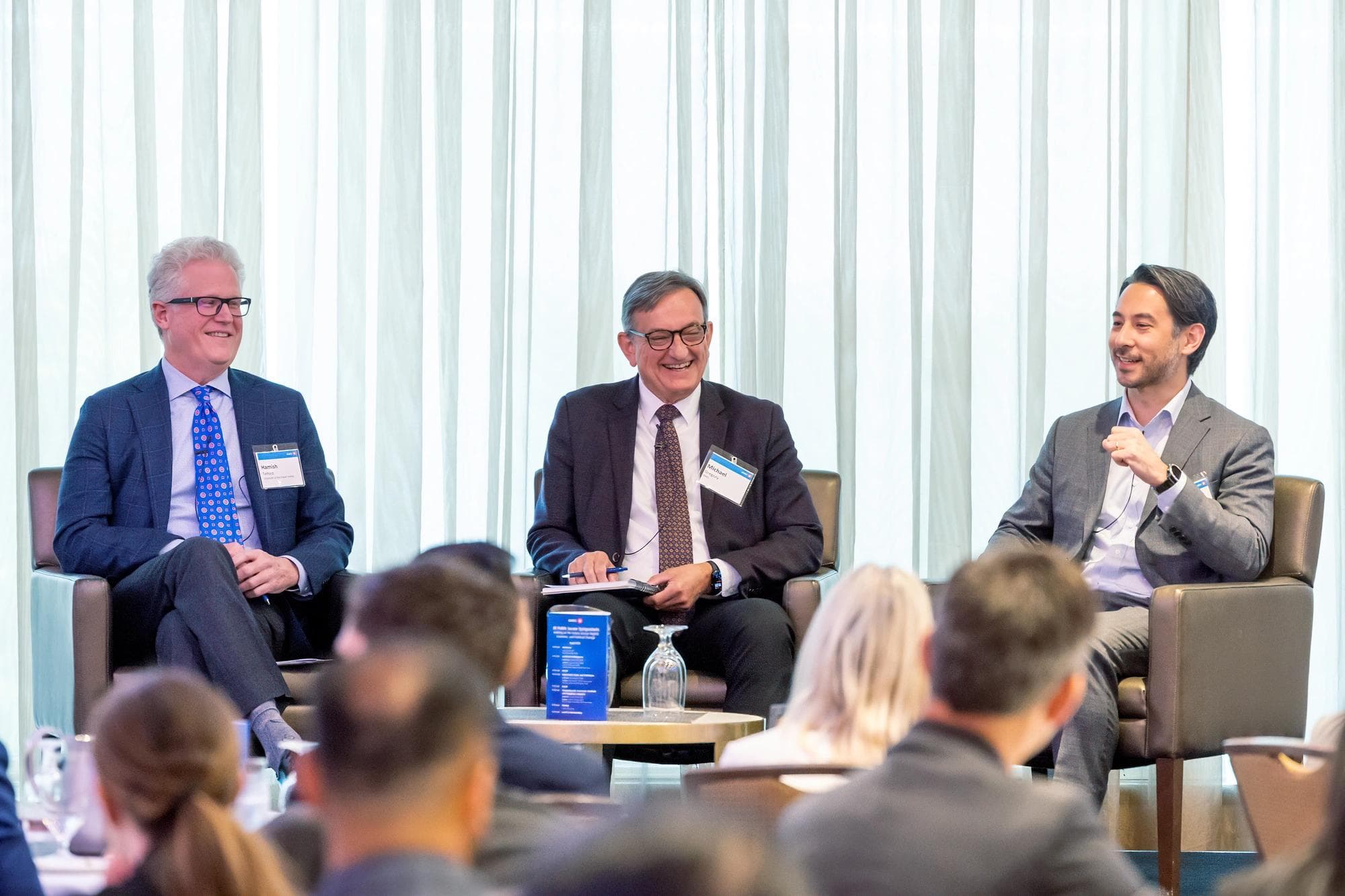
Whispers of a recession have been floating in the air for the first time in a long while. Michael Gregory, BMO’s Deputy Chief Economist, provided context about what this bodes for the macroeconomic backdrop.
The Canadian economy contracted at a 0.1% annual rate in the first quarter, after a decline in the fourth quarter. But that doesn’t necessarily mean a recession is on the horizon. From an economist’s perspective, that would require what Gregory calls the “three Ds”—depth, duration, and dispersion. According to Gregory, one of those factors is lacking.
“Dispersion is the part that’s a little more difficult,” he said. “The trade sector is one of the weakest because it’s being hit by the trade war with the U.S. But if you strip that out, domestic demand, consumer spending, business spending, and government spending on a year-over-year basis continue to grow at about 1.5%, which is not great, but it's definitely not a recession.”
Every province is currently running a deficit, and British Columbia recently faced downgrades from multiple credit rating agencies. Gregory acknowledged that “the fiscal situation is bleak” and will likely lead to spending cuts, which will hit government entities and organizations that rely on government funding particularly hard. “We’re looking at leaner times going ahead as we begin to deal with a deficit that got out of hand that has eventually to be brought back in line,” he said.
Balancing budget priorities with voter demands, however, could be a difficult task. “Voters want everything,” said Hamish Telford, Associate Professor of Political Science at the University of the Fraser Valley. “They want better and more public services, they want better schools for their kids, they want better infrastructure, public transit, and public safety, and they would like their taxes to be lower as well. This doesn't give governments a lot of room to maneuver.” Faced with these demands, governments at the provincial and federal level have chosen to run deficits and keep spending.
On the topic of interprovincial trade, however, Telford sees reason for optimism. “It's painstaking work,” he said. “A lot of this involves trying to harmonize regulations across provinces. But at least there's a sense now that we have to seize this moment because it's relatively low-hanging fruit. We're in a global context where we don't have a lot of control, but we do have control over that portion of our economy.”
A growing forum
Attendance at BMO’s BC Public Sector Symposium has grown each year since the event began four years ago. It's a reflection of the increasing diversity of participating organizations, as well as the continued relevance of the guidance offered, particularly in the context of navigating the significant economic, policy, and technological shifts that have an impact on sectors so vital to our communities.
“This is one of the highlights of our year, and it's never been more important for us to bring finance leaders from the public sector and Indigenous sector together and engage with our clients from around the region to talk about the issues and developments that impact them”, said Arreaga.